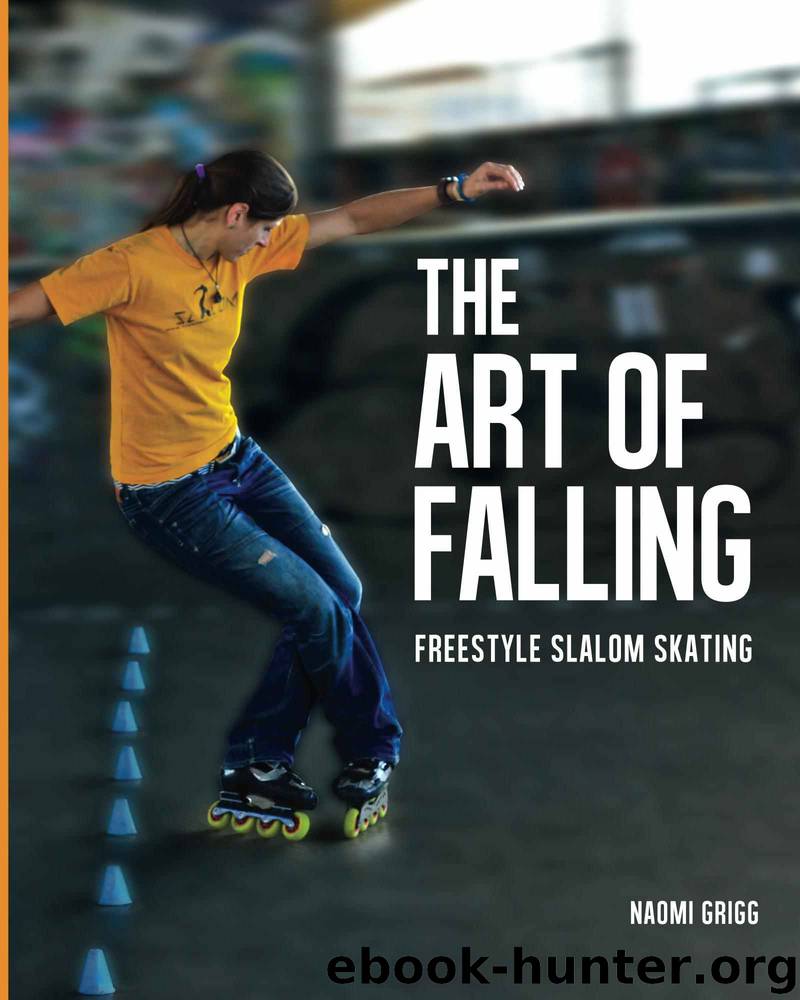
The Art of Falling: Freestyle Slalom Skating by Naomi Grigg
Author:Naomi Grigg [Grigg, Naomi]
Language: eng
Format: azw3
Publisher: Patson Media LLC
Published: 2014-05-31T16:00:00+00:00
Screw
The Screw (sometimes known as the backward Korean Volte) is a great example of a trick which cannot easily be broken down into its component pivots. It is like being given a pancake and being told to find out the ingredients.
The pivots are the backward crossed-behind toe pivot (Volte), and the forward crossed-in-front toe pivot (J-turn).
Usually, someone will get comfortable on their two toe wheels and then learn Screw. Then the troubleshooting begins. One aspect of which will be their hips and upper body – very important components to get right when doing any spin. They will struggle for a long time, gradually gaining awareness of their hips, arms, shoulders, head, etc. Then they will learn to control them one by one. Finally they will be able to correct them all at once and they will be able to do a sustainable Screw.
By learning Screw as a combination of two pivots, it enables you to get your hips and upper body consistently correct while being on 5 wheels instead of 2 wheels. This affords you more time and brainpower to be directed towards getting these aspects correct and ingrained in your muscle memory. Then when you do the Screw for real the body will no longer be a problem.
Another troubleshooting aspect for Screw is the position of the feet and legs. Usually the legs are not crossed well because it is a pretty unnatural position to be in. It is usually the J-turn which is the weaker pivot and needs work. The ideal edges for Screw are inside edges for both toes. This is almost impossible unless you can do Butterfly (Screw position, but going in a straight line like a side-surf instead of a spin) however working on the Volte and J-turn pivots will help bring you away from extreme outside edges.
When you are trying to make the Screw travel along, usually you will find that one of your toes will facilitate you moving along the cones, and one will not. This is where you need to practise doing both pivots on only the toes. Surprisingly it is usually the Volte which is the problem here.
Download
This site does not store any files on its server. We only index and link to content provided by other sites. Please contact the content providers to delete copyright contents if any and email us, we'll remove relevant links or contents immediately.
Shoe Dog by Phil Knight(5252)
The Rules Do Not Apply by Ariel Levy(4946)
Walking by Henry David Thoreau(3946)
How to Read Water: Clues and Patterns from Puddles to the Sea (Natural Navigation) by Tristan Gooley(3454)
Running Barefoot by Amy Harmon(3437)
I'll Give You the Sun by Jandy Nelson(3424)
Crazy Is My Superpower by A.J. Mendez Brooks(3384)
How to Read Nature by Tristan Gooley(3322)
How Music Works by David Byrne(3252)
The Boy, the Mole, the Fox and the Horse by Charlie Mackesy(3104)
The Fight by Norman Mailer(2920)
Seducing Cinderella by Gina L. Maxwell(2636)
Cuba by Lonely Planet(2624)
Accepted by Pat Patterson(2359)
Going Long by Editors of Runner's World(2349)
The Unfettered Mind: Writings from a Zen Master to a Master Swordsman by Takuan Soho(2291)
Backpacker the Complete Guide to Backpacking by Backpacker Magazine(2236)
The Happy Runner by David Roche(2227)
Trail Magic by Trevelyan Quest Edwards & Hazel Edwards(2172)
